...when you get an email from HMV saying you can download a free song of your choice (not some rubbish they’re trying to promote) from their website with this code – DLX06 (go on, you try it) – and you put on the laptop especially, because you have all your music on it since the old PC’s disc drive is kaput and you log on to the HMV website and enter the code and IT’S NOT RECOGNIZED?
Slap! (I had to get that off my chest: enough with this goodwill nonsense.)
Wednesday, 27 December 2006

Sunday, 24 December 2006

Friday, 22 December 2006
Guess where I was!

Before I left London, last Friday, one of my commenters wished me ‘a weekend without slaps’. Ha! The gods were reading my blog that day.
Our trip started very badly: when my partner and I turned up at our local underground station to get to Waterloo, we were stopped at the gates by a guard who told us the Central Line wasn’t running. I have to admit that panic ensued – we only had two and a half hours to get there, after all. No, I’m kidding; we did have plenty of time but the night before I had joked that in my experience the journey from Shepherds Bush to Waterloo had never taken longer than 45 minutes so why were we allowing so much time. Again, the gods were listening. Lots of shouting and cursing and tears (well, maybe not tears, but, you know), lots of running around like demented fleas; lots of wild trundling of uncool suitcases on wheels (I lost a very nice shiny padlock in the scramble); lots of arm waving in an attempt to hail engaged, heartless cabs, and finally, as we were running in the direction of the other Shepherds Bush station, the one on the Metropolitan Line, the line where trains amble along at a snail’s pace, a line that might or might not have taken us eventually to Waterloo, we spotted a black cab that had just dropped someone off at the BBC studios, down the road. It was at a standstill at the traffic lights and was going nowhere that particular instant but we ran towards it as if it was going to suddenly take off vertically like a helicopter and escape our grasp. We could have kissed the driver. It was a miracle. If you’ve ever tried to hail a cab on a Friday afternoon in London, when a major tube line isn’t working, you’ll know what I mean. So, my First Slap goes to London Underground for the stress they caused us even before we’d left the city.
Onboard the Eurostar, we were sitting in those stupid facing seats that should be reserved for chamber-music quartets or families and never allocated to strangers. The American woman next to me was one of the most inconsiderate people I’ve had the misfortune to travel with: at one point I couldn’t see my partner, who was sitting in front of me, because I had a Guardian double spread before my eyes – and I wasn’t the one reading it! My Second Slap goes to her.
My Third Slap I’m awarding to the drunk who insulted me, and several other women, in French and English (he was surprisingly fluent in both languages), after I’d jumped to the rescue of the young Japanese woman (complete with cello and mute mother – she only spoke Japanese, I expect) he was pestering, while we were queuing for a taxi at the Gare du Nord. He became very offensive and for some reason attacked my hair – luckily, only verbally. Apparently, since I have white hair, I’m going to die soon so I should shut up. Nice! Finally, a young woman, who was even more bothered by him than I was, left her place in the queue (that showed how incensed she was: no one in their right mind would ever do that) and went to get the police. By then the man had gone. In the meantime, my partner and I had made a few friends in the queue, and chatting away with them made the next ten hours seem like minutes.
From then on, lots of mishaps, near misses, bag panics, scarf panics (whatever you do, never ever offer to carry someone else’s plastic bag in case they shoved their scarf into it when they boarded a bus, instead of putting it in their handbag as usual: you will save them the stress and humiliation of running after the bus they’ve just alighted from, shouting, ‘My scarf, my scarf, I left my – expensive, but reduced in TK Maxx, beautiful merino wool – scarf on the bus!’ only for them to find it in above-mentioned plastic bag after kind bus driver looks for it in vain and shrugs in very French manner), glove panics (N.B. Paris in December is cold, take pair of warm gloves: will save you having to hurriedly buy non-needed – because already three pairs at home – gloves in nearest Monoprix, when your ‘little hand is frozen’). Also, at your hotel, when you go down to breakfast on your last day, after you’ve exhorted your partner not to leave anything valuable in the room, do not place your handbag on the floor by your chair and go back up to your room, after drinking your first cup of tea (made with a redbush tea sachet you brought all the way from London because you don’t drink real tea or coffee), holding only your key and the croissant you intend to eat a bit later: your heart will stop beating completely when you realize, an hour later, just as you’re packing the last few things in your still uncool suitcase, that you are sans handbag, credit cards, passport, ticket, etc. You will have to fly down four flights of stairs, shrieking, ‘I left my handbag downstairs! I left my handbag downstairs! No, I’m not all right!’ (This last exclamation to the maid who’s cleaning one of the rooms and who’s just asked, ‘Ça va?’ as you’re zooming down the stairs.) Your heart will restart only when the hotel manager hands you your bag, which he retrieved from under the table an hour earlier but didn’t think to return to you as soon as. I guess my Fourth Slap goes to me – and him.
Last but not least, the Fifth Slap has to be awarded to a brasserie called Relais Paris Opéra (Rue Auber; make a note of it) for charging 9,40€ – that’s over £6.00 for a large (ok, a very large) coke. And £3.50 for a very small goat cheese with nothing else on the plate (you look for a few salad leaves, a couple of French fries, nope, nothing). It lies in wait for people who’ve been traipsing all over Paris in the cold and the rain and who are ready to drop and then it pounces. Stay away from it. You have been warned.
I suppose the rain deserves to be slapped too. It appeared on Saturday morning and didn’t let up all day. Everything takes twice as long in the rain and battling with dripping umbrellas is not my idea of fun. An English friend of mine, who, I discovered later, was in Paris just for the day, was even more unlucky than we were. At least Sunday was dry.
End of Slaps. Let the Hugs begin!


The Christmas lights on the Champs-Elysées and elsewhere were absolutely lovely. The Eiffel Tower was soooo pretty, all glittery and twinkly. Tea at Angelina’s with my best friend and her 22-year-old daughter, whom I last saw when she was three days old, was delightful. Everyone we came across was very very nice: young waitresses, who, here in London would plonk stuff in front of you with a snarl, were charming and smiley, and café owners let us (well, me mostly) use their loos with a cheerful, ‘Mais, bien sûr, Madame!’ even though I never drank anything (I mention them because I became acquainted with an awful lot of those loos: my IBS flared up like crazy from day one – thanks to all the stress, as detailed above). It’s a myth that Parisian shopkeepers, etc. are sulky and unpleasant: for sulky and unpleasant you have to come to London.


At the Bazar de l’Hôtel-de-Ville (BHV to its friends) – the Parisian John Lewis, a most underrated department store that stocks practical items as well as objets de luxe, I found, at last, great zip-up nylon bags where my delicate sweaters will be protected from those pesky moths that have infested all our drawers. The BHV was crowded but, unlike the other Grands Magasins, it didn't make you lose the will to live.
And then there was the First Floor at the Salons du Palais-Royal (this will mean something to my Frag Board friends, everyone else will just have to remain puzzled), and being welcomed like a VIP there. Finally, the Ladurée cart, inside one of the entrances of the Printemps, and the two macaroons (one each) we managed to savour in a terrible draught, right under these lights. They were scrumptious.
End of Hugs. Resume Slaps.
The journey back was the most peaceful, restful, pleasant I’ve ever had on the Eurostar: it was very late and everyone was exhausted so not in the mood to chat or be noisy some other way. We got a cab pretty quickly and arrived back at our building to discover that the heating had broken down that day. That was Sunday night; this has been one of the coldest weeks yet (flights, etc. have been cancelled because of the freezing fog); the heating has only just been repaired. Life goes on…

Friday, 15 December 2006
Happy Hanukkah!
I’m off…
…somewhere. Just for the weekend, but, since I haven’t really been anywhere – apart from around the corner – for four years, it’s a BIG deal for me. All will be revealed on my return.
I wish I could remove the moderation so my two readers could leave comments freely, but they would soon be joined by all those people who try to leave messages about all sorts of ridiculous things (I have an Inbox full of them) so comments will have to wait until Monday.
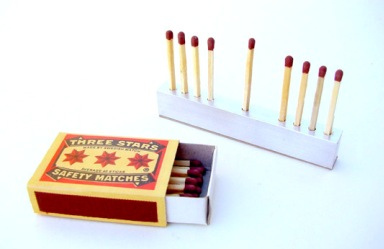
Had I seen it before, I would have bought this portable and minimalist menorah to take with me on my trip. LOL! It’s called Hanukit and was designed by Reddish Studio. It can be found here.
Wednesday, 13 December 2006
An obscene amount of money
No, I’m not being Richard Gere in Pretty Woman (wasn’t that a great scene, by the way?) nor is it the sum of money I’m going to spend this Christmas, I’m referring to the bonus the boss of Goldman Sachs got this year.
Fifty million pounds sterling (£50m). As a bonus!
I can’t get my head round this figure. It makes me feel nauseous.
Years ago, when I worked in publishing, we all used to get a bonus with our last salary of the year (the company was very successful): mine was usually just about enough to pay for a bottle of perfume or something like that, but it was still a nice little extra. My boss's bonus was always much more substantial. One year, she opened the small brown envelope that contained her salary slip and exclaimed, ‘Oh goody, I can book my trip to Tibet now!’
Fifty million pounds is obscene, though.
Slap!
Fifty million pounds sterling (£50m). As a bonus!
I can’t get my head round this figure. It makes me feel nauseous.
Years ago, when I worked in publishing, we all used to get a bonus with our last salary of the year (the company was very successful): mine was usually just about enough to pay for a bottle of perfume or something like that, but it was still a nice little extra. My boss's bonus was always much more substantial. One year, she opened the small brown envelope that contained her salary slip and exclaimed, ‘Oh goody, I can book my trip to Tibet now!’
Fifty million pounds is obscene, though.
Slap!
Thursday, 7 December 2006
Er, thanks for caring... I suppose
The phone rings. I pick up the receiver and hear a computerized voice saying, ‘Hullo! This is an important message for Miss X [my name badly mispronounced – this isn’t starting very well…] from Y [the name of a bank that doesn’t like to say ‘yes’ or ‘no’ or anything at all, in fact, usually, and certainly never calls me in the evening]. We have noticed suspicious activity on your credit card. Please contact us at this number as soon as possible: 0845, etc. etc.’ I go, ‘Don’t be so silly, you fraudulent people you!’ And put the phone down.
The next day, the same message is left on my answerphone. Ok, I can’t ignore it again; I need to tell my bank that someone is calling their customers, panicking them and asking them to call them back. Obviously, if they do they will be confirming that they are who those fraudsters think they are and will be ripped off somehow.
Except that it was my bank calling me.
They should have asked me to call the number I’m used to calling the rare times I feel like a chat with them, not a different – and, to me, suspicious – one.
It’s slightly creepy, isn’t it? There are people out there who are sitting in front of computer screens and scrutinizing our purchases. ‘Oh, look, she bought something for 32p in TK Maxx the other day. Wonder what it is.’
Slap!
The next day, the same message is left on my answerphone. Ok, I can’t ignore it again; I need to tell my bank that someone is calling their customers, panicking them and asking them to call them back. Obviously, if they do they will be confirming that they are who those fraudsters think they are and will be ripped off somehow.
Except that it was my bank calling me.
‘What fraudulent activity? I’ve just checked on the Net; there’s nothing unusual there.’Hey, don’t get me wrong: I’m delighted they’re looking after me and my peanuts so well, but leaving scary messages on answerphones is not on. We keep getting told not to believe anything; not to click on links in emails, for instance, in case they’re ‘phishing’ emails so I said to the nosy man, ‘Who in their right mind is going to call a number they’ve never heard of before, these days? That number isn’t mentioned anywhere in your literature.’ ‘It’s on the back of your credit card.’ I checked: it wasn’t.
‘Well, the day before yesterday you spent £1.28 in Tesco, instead of your usual £1.23. And yesterday you spent 59p in Superdrug; you never buy anything in Superdrug.’
‘So?’
They should have asked me to call the number I’m used to calling the rare times I feel like a chat with them, not a different – and, to me, suspicious – one.
It’s slightly creepy, isn’t it? There are people out there who are sitting in front of computer screens and scrutinizing our purchases. ‘Oh, look, she bought something for 32p in TK Maxx the other day. Wonder what it is.’
Slap!
Friday, 1 December 2006
Guest Slapper of the Month XI
We, in the Blogosphere, are all in awe of TLP of Tan Lucy Pez: there is no one who is more quirky, more touching, more humorous. No one makes me hoot with laughter the way she does. No one. Here she is in serious mode, though. She can do that too. That TLP! (Sorry, couldn’t resist it. LOL!)

Only the rich can buy health care in America.
The only problem with delivering a SLAP! is narrowing my focus down to one slap. There are a lot of people/groups that I would happily slap. But the one SLAP that I decided on is so obviously over the top, that I just had to go with it. Nope, not anything to do with O.J. Simpson. Anything to do with him is a waste of a good tirade or a slap.
I’m slapping the Los Angeles Metropolitan Medical Center in California. This hospital dumped hospital patients on Skid Row in L.A. These sick folks were indigent of course. And they were taken to Skid Row by ambulance. That’s right. They were sick enough to be taken by ambulance, and then dumped with no one to care for them.
According to National Public Radio (NPR), the 50 square blocks of Skid Row are home to more than 10,000 people with no where else to go. It has many shelters, social service agencies -- as well as convicted sex offenders and just about any illegal drug you can think of. It’s a horrible, crime-plagued area.
In other words, it's no place for someone who's still sick enough to be transported in an ambulance. But on a recent Sunday, Los Angeles police captured video and still photos of five patients from this single hospital being dumped in this unsafe and unclean area.
When the police interviewed a couple of ambulance drivers they found out that the drop-offs were not a fluke. It was a plan to rid the hospital of indigents. This plan had been in use for some time.
But wait! It turns out that other hospitals in the L.A. area are doing this too!
The hospital staff at Kaiser Permanente’s Bellflower hospital called a cab and paid the driver to take older woman with dementia to skid row and drop her off, according to a Los Angeles Times story reporting on “the first criminal prosecution of a medical center accused of ‘dumping’ patients on skid row.” Earlier this year the 63-year-old patient, Carol Ann Reyes, was videotaped leaving in the taxi from Kaiser Bellflower hospital in LA. She was taken away in her hospital gown and socks, and she was found wandering skid row streets. Reyes had never lived on skid row and was unfamiliar with the area. She was a homeless person, so she was dumped.
The bigger, perhaps better, slap would be to the people of the United States. We don’t have health care for everyone, and as a group we don’t care about our homeless. But I never thought that we would come to this. SLAP!
Only the rich can buy health care in America.
The only problem with delivering a SLAP! is narrowing my focus down to one slap. There are a lot of people/groups that I would happily slap. But the one SLAP that I decided on is so obviously over the top, that I just had to go with it. Nope, not anything to do with O.J. Simpson. Anything to do with him is a waste of a good tirade or a slap.
I’m slapping the Los Angeles Metropolitan Medical Center in California. This hospital dumped hospital patients on Skid Row in L.A. These sick folks were indigent of course. And they were taken to Skid Row by ambulance. That’s right. They were sick enough to be taken by ambulance, and then dumped with no one to care for them.
According to National Public Radio (NPR), the 50 square blocks of Skid Row are home to more than 10,000 people with no where else to go. It has many shelters, social service agencies -- as well as convicted sex offenders and just about any illegal drug you can think of. It’s a horrible, crime-plagued area.
In other words, it's no place for someone who's still sick enough to be transported in an ambulance. But on a recent Sunday, Los Angeles police captured video and still photos of five patients from this single hospital being dumped in this unsafe and unclean area.
When the police interviewed a couple of ambulance drivers they found out that the drop-offs were not a fluke. It was a plan to rid the hospital of indigents. This plan had been in use for some time.
But wait! It turns out that other hospitals in the L.A. area are doing this too!
The hospital staff at Kaiser Permanente’s Bellflower hospital called a cab and paid the driver to take older woman with dementia to skid row and drop her off, according to a Los Angeles Times story reporting on “the first criminal prosecution of a medical center accused of ‘dumping’ patients on skid row.” Earlier this year the 63-year-old patient, Carol Ann Reyes, was videotaped leaving in the taxi from Kaiser Bellflower hospital in LA. She was taken away in her hospital gown and socks, and she was found wandering skid row streets. Reyes had never lived on skid row and was unfamiliar with the area. She was a homeless person, so she was dumped.
The bigger, perhaps better, slap would be to the people of the United States. We don’t have health care for everyone, and as a group we don’t care about our homeless. But I never thought that we would come to this. SLAP!
Sunday, 26 November 2006
You did ask
In my previous post I said en passant that ‘I liked the Berlin Wall’ and someone expressed surprise and dismay. I was going to answer it was obviously a joke and since my post was about my being bad at geography it just meant that before the fall of the Wall in 1989 and the dismantlement of the USSR the map of Europe was much simpler and easier to commit to memory. But, it wasn’t a joke: it was a serious remark ‘masquerading’ as a joke.
Why on earth did I not rejoice – like everyone else, it seemed – when the Wall was knocked down and all those people freed themselves from the yoke of Communism? I try to be honest on this blog so I will tell you why.
This is why:
Because for every one German who was murdering Jews in the Ukraine during the war ten local people were volunteering to help with their dirty work and murder Jews in broad daylight.
Because Slovakia, under Jozef Tiso (a Roman Catholic priest), adopted its own version of the German anti-Jewish laws in April 1939, long before it was occupied by the Germans, and deported 70,000 Jews.
Because Hungary and Romania became Nazi allies very early on, in 1940. When the war was already lost, between April and June 1944 (D-Day was on 6 June), 435,000 Hungarian Jews were deported to concentration camps with the help of the local population.
Because Serbia was declared ‘free of Jews’ in 1942, thanks to the efforts of the government.
Because Lithuania had auxiliary military units under Nazi detachments.
Because there was a Latvian volunteer police unit that shot 26,000 Jews at various locations.
Because there were local Nazi collaborators in Estonia... Croatia... Bulgaria...
I cringe and feel queasy every time I hear any of those names on the radio or the television, and I would rather the inhabitants of those countries were still safely hidden away behind the Iron Curtain and I wasn’t aware of their existence so much. Anti-Semitism was never eradicated during the Soviet years but it wasn’t allowed to flourish, as it is now once again. The Orthodox Church (and the Catholic Church too) has regained its influence over the population, and nationalist movements are getting stronger by the day. Hundreds of magazines are once again spreading anti-Semitic propaganda all over Eastern Europe.
In July 1946, i.e. minutes after the true horror of what had happened in Eastern Europe was revealed to the rest of the world, there was a pogrom – a pogrom! – in Kielce, Poland. Germany, where 44 per cent of the population voted for Hitler, has apologized and made amends. But the other countries haven’t and continue to deny their part in the Holocaust. If it’s ever shown where you live, watch the shocking Channel 4 series Holocaust, which recently broadcast hitherto unseen footage of Nazi sympathisers committing the same horrific deeds as their German counterparts. And if you haven’t seen it yet rent out Shoah by Claude Lanzmann and see how Eastern European peasants who lived a few miles from Auschwitz or other concentration camps acknowledge they knew what was going on and at the same time refuse to feel any remorse or shame about letting it happen. See how people live in houses still bearing Jewish insignia. ‘How did you get to move into this house?’ they’re asked. ‘The Jews “went away”.’
And, then, there’s France, where, before the war, my father had a business, a business that was taken over by the Vichy government. The first document below, dated 4 June 1941 and issued by the ‘Commissariat Général aux Questions Juives’, says that a Monsieur Georges (may he rot in hell!) has been appointed to manage my father’s business. The second document, dated 12 June 1941, says the business doesn’t belong to my father any longer and he’s now just a ‘technical adviser’. He must stop using any of his bank accounts immediately, give Monsieur Georges complete access to his premises and his account books, and provide him with any information he may need in order to manage the business. Furthermore, he must be at his disposal in situ until further notice.
Why on earth did I not rejoice – like everyone else, it seemed – when the Wall was knocked down and all those people freed themselves from the yoke of Communism? I try to be honest on this blog so I will tell you why.
This is why:
Because for every one German who was murdering Jews in the Ukraine during the war ten local people were volunteering to help with their dirty work and murder Jews in broad daylight.
Because Slovakia, under Jozef Tiso (a Roman Catholic priest), adopted its own version of the German anti-Jewish laws in April 1939, long before it was occupied by the Germans, and deported 70,000 Jews.
Because Hungary and Romania became Nazi allies very early on, in 1940. When the war was already lost, between April and June 1944 (D-Day was on 6 June), 435,000 Hungarian Jews were deported to concentration camps with the help of the local population.
Because Serbia was declared ‘free of Jews’ in 1942, thanks to the efforts of the government.
Because Lithuania had auxiliary military units under Nazi detachments.
Because there was a Latvian volunteer police unit that shot 26,000 Jews at various locations.
Because there were local Nazi collaborators in Estonia... Croatia... Bulgaria...
I cringe and feel queasy every time I hear any of those names on the radio or the television, and I would rather the inhabitants of those countries were still safely hidden away behind the Iron Curtain and I wasn’t aware of their existence so much. Anti-Semitism was never eradicated during the Soviet years but it wasn’t allowed to flourish, as it is now once again. The Orthodox Church (and the Catholic Church too) has regained its influence over the population, and nationalist movements are getting stronger by the day. Hundreds of magazines are once again spreading anti-Semitic propaganda all over Eastern Europe.
In July 1946, i.e. minutes after the true horror of what had happened in Eastern Europe was revealed to the rest of the world, there was a pogrom – a pogrom! – in Kielce, Poland. Germany, where 44 per cent of the population voted for Hitler, has apologized and made amends. But the other countries haven’t and continue to deny their part in the Holocaust. If it’s ever shown where you live, watch the shocking Channel 4 series Holocaust, which recently broadcast hitherto unseen footage of Nazi sympathisers committing the same horrific deeds as their German counterparts. And if you haven’t seen it yet rent out Shoah by Claude Lanzmann and see how Eastern European peasants who lived a few miles from Auschwitz or other concentration camps acknowledge they knew what was going on and at the same time refuse to feel any remorse or shame about letting it happen. See how people live in houses still bearing Jewish insignia. ‘How did you get to move into this house?’ they’re asked. ‘The Jews “went away”.’
And, then, there’s France, where, before the war, my father had a business, a business that was taken over by the Vichy government. The first document below, dated 4 June 1941 and issued by the ‘Commissariat Général aux Questions Juives’, says that a Monsieur Georges (may he rot in hell!) has been appointed to manage my father’s business. The second document, dated 12 June 1941, says the business doesn’t belong to my father any longer and he’s now just a ‘technical adviser’. He must stop using any of his bank accounts immediately, give Monsieur Georges complete access to his premises and his account books, and provide him with any information he may need in order to manage the business. Furthermore, he must be at his disposal in situ until further notice.

Needless to say, my father left Paris at once and hid here and there for the duration of the war. By some miracle, he managed to recover his looted flat cum workshop several months after the end of the war.
I should cringe and feel queasy when I hear the words ‘France’ and ‘French’ – just as I do with the other names mentioned above, but I can’t: my father chose to stay in the country and that's where I was born. The French are only just starting to come to terms with the fact that, contrary to what they have told themselves and others over the years, they weren’t all in the Résistance and quite a lot of them in fact have a shady past. If you want to know more about the German Occupation in France, watch Le Chagrin et la Pitié by Marcel Ophüls, and listen to shameless ex-collaborators lie and try to justify their crimes.
Perhaps, in time, I will get used to hearing those names and stop wondering what the people concerned or their parents were doing during the war, but it’s still a bit too soon.

Addendum (28/11/06): I should probably have mentioned this before: I have a personal grievance against those unrepentant Eastern European Nazi collaborators: I'm not just outraged on behalf of other Jewish people or because I've seen film footage of what they did.
In July 1941, the Germans occupied a small town in Belarus, called Shklov. By the end of the year, they had killed almost all the Jews. Local fascists killed 6,000 men, women near the town. According to an eyewitness, ‘the children were put alive into a pit with their murdered parents and the pit was filled up’. My father’s family were probably thrown into that pit.
During the night of 13 July 1942, the inhabitants of the Rowno Ghetto (Ukraine), where there were still about 5,000 Jews, were liquidated. According to an eyewitness who testified at the Nuremberg Trials, ‘shortly after 22.00 hours the Ghetto was encircled by a large SS detachment and about three times as many members of the Ukrainian Militia.’ My mother’s family were probably among the people who were massacred that night.Wednesday, 22 November 2006
Where am I?
I have this little book where I keep newspaper cuttings that have made me go, ‘I don’t believe it?’, and, since nothing majorly annoying has happened since Saturday (if you don’t count the fact that some more of my bathroom tiles have fallen off the walls; I did help by banging them with a metal bar, but they were holding on by a thread and threatening to land on my head while I had my next shower…), since nothing majorly annoying has happened since Saturday (thought you might have lost the thread by now), since nothing, no, I’m not repeating it again, I thought I would take out one of those cuttings and share with you something that stunned me recently.
Apparently, ‘more than 20,000 children in London do not know they live in the capital. One in five six- to 14-year-old British children cannot find the UK on a map of the world and one in 10 was not able to name a single continent. Boys had slightly better geographical skills, with 65 per cent being able to locate countries compared with 63 per cent of girls. Scottish children were the most geographically aware.’ (London Evening Standard)
I was never very good at geography; I’m still a bit vague on quite a lot of countries (I liked the Berlin Wall for all sorts of reasons) and there are some countries I don’t believe in at all, like Colombia. Don’t ask me why. It’s a quirk I have. Still, I do know where I am, most of the time, and when I was between six and 14 I knew I lived in the capital of France. After that, it became more complicated and confusing: a few years here, a few years there…
Slapping those British kids and myself for not paying more attention during those excruciatingly boring lessons!
Apparently, ‘more than 20,000 children in London do not know they live in the capital. One in five six- to 14-year-old British children cannot find the UK on a map of the world and one in 10 was not able to name a single continent. Boys had slightly better geographical skills, with 65 per cent being able to locate countries compared with 63 per cent of girls. Scottish children were the most geographically aware.’ (London Evening Standard)
I was never very good at geography; I’m still a bit vague on quite a lot of countries (I liked the Berlin Wall for all sorts of reasons) and there are some countries I don’t believe in at all, like Colombia. Don’t ask me why. It’s a quirk I have. Still, I do know where I am, most of the time, and when I was between six and 14 I knew I lived in the capital of France. After that, it became more complicated and confusing: a few years here, a few years there…
Slapping those British kids and myself for not paying more attention during those excruciatingly boring lessons!
Saturday, 18 November 2006
Being rude in an email is... being rude
I don’t work full-time as a translator any longer. The short deadlines I used to have to meet were killing me – literally. Until recently I was still doing three ‘big’ jobs a year, now I have only two left (hope I didn’t jinx them for next year): you may have read the story of how I lost the third one. Anyway, since those jobs aren’t enough to live on – far from it – I also update a couple of guidebooks a year for a well-known publishing company specializing in helpful tomes (they are rather big and heavy) for the ‘discerning traveller’.
In order to get up-to-date information, I email all the tourist offices mentioned in the guides and kindly ask them to send me their address, phone number, URL and opening hours. Things like that. I leave spaces for them to fill in the details and all they have to do is to return the email to me. Since I need to update information about hotels, restaurants, museums, etc., I also ask them if they would be so kind as to send me any brochures they might have, because, although everyone has a website these days, I’m not paid by the hour and don’t have the time to trawl the Internet and search through hundreds of sites that are all organised differently (some websites are very good at hiding info). Most of the tourist offices understand my predicament and send me loads of literature; I plunder it and write down anything that’s new, before phoning most places to find out what is still missing. There’s always something, but at least it cuts down on expensive phone calls abroad (they’re not paid for by my employers).
I am currently updating the guide to Provence. Last week I emailed the tourist offices and, as usual, mostly got wonderfully courteous responses from them, and a whole pile of brochures is at this very moment sitting my floor, ready to be taken apart by me.
I said ‘mostly’ because this is what I received a couple of days ago from the tourist office of a very very small place near Arles. The person (a woman) filled in (badly) the blank spaces in my email and added this – in bold red type – at the bottom of it, before returning it to me:
I wrote back to her and told her who I was and what my qualifications were. She apologized. She said ‘culture’ is what matters to her most of all; she deplores the lack of it these days and she thought I was one of those people who didn’t have any. What, in my well-phrased email (in French, I hasten to add), with its correct spelling, grammar and punctuation, made her think that, I don’t know (especially since her email contains no less than six grammatical errors). Furthermore, the whole point about what I’m doing is that not much ‘culture’ is required: all you need is to be able to speak and write the language properly and be very thorough. I am not ‘writing’ the guide; I am just ‘updating’ it. Keep also in mind that it is November and that the village in question is most probably devoid of tourists at the moment so the woman is unlikely to be overworked and short of time. Anyway, she works in a tourist office, what else is she supposed to do but supply information about her village?
I’m sure she would never have said any of that to my face. Although she signed her name, she must have felt protected by the anonymity afforded by the Internet. That was what allowed her to behave in such an outrageous way.
Slap!
In order to get up-to-date information, I email all the tourist offices mentioned in the guides and kindly ask them to send me their address, phone number, URL and opening hours. Things like that. I leave spaces for them to fill in the details and all they have to do is to return the email to me. Since I need to update information about hotels, restaurants, museums, etc., I also ask them if they would be so kind as to send me any brochures they might have, because, although everyone has a website these days, I’m not paid by the hour and don’t have the time to trawl the Internet and search through hundreds of sites that are all organised differently (some websites are very good at hiding info). Most of the tourist offices understand my predicament and send me loads of literature; I plunder it and write down anything that’s new, before phoning most places to find out what is still missing. There’s always something, but at least it cuts down on expensive phone calls abroad (they’re not paid for by my employers).
I am currently updating the guide to Provence. Last week I emailed the tourist offices and, as usual, mostly got wonderfully courteous responses from them, and a whole pile of brochures is at this very moment sitting my floor, ready to be taken apart by me.
I said ‘mostly’ because this is what I received a couple of days ago from the tourist office of a very very small place near Arles. The person (a woman) filled in (badly) the blank spaces in my email and added this – in bold red type – at the bottom of it, before returning it to me:
Un peu de perspicacité, de curiosité, de créativité, surtout si il s'agit d'enrichir sa culture personnelle et rendre son travail plus intéressant me semble indispensable lorsque l'on travaille dans le tourisme. A quoi servirait tous ces outils fantastiques mit à notre disposition (le dialogue, le téléphone, internet etc. …) si non à l'enrichissement personnel, à la communication avec l'autre, avec le monde ENTIER.It translates like this:
Il est bien plus facile de suivre la culture du pré-mâché, du pré-pensé et suivre le chemin de l'uniformité en recopiant les informations que j’aurais pris le temps de vous transmettre, car mon temps n'est jamais compté.
Avec toute mon compassion
A little perspicacity, a little curiosity, a little creativity, especially if it means enriching one’s personal cultural knowledge and making one’s work more interesting, seems to me to be essential when one is working in the tourist industry. What would be the use of all those fantastic tools we have at our disposal (face-to-face communication, telephone, the Internet, etc.) if not for one’s personal development, for communicating with others, with the WHOLE world.My jaw dropped when I read it. I was so shocked. I felt as if I’d been slapped. That woman doesn’t know me. How dare she assume that I’m some ignorant, lazy and narrow-minded person who is scared of new technology! How can anyone be so rude and patronizing?
It is much easier to settle, like everyone else these days, for what is pre-digested, pre-thought, and follow the path of uniformity by copying down information that I would take the time to send you, since my time is never taken into account.
With all my sympathy
I wrote back to her and told her who I was and what my qualifications were. She apologized. She said ‘culture’ is what matters to her most of all; she deplores the lack of it these days and she thought I was one of those people who didn’t have any. What, in my well-phrased email (in French, I hasten to add), with its correct spelling, grammar and punctuation, made her think that, I don’t know (especially since her email contains no less than six grammatical errors). Furthermore, the whole point about what I’m doing is that not much ‘culture’ is required: all you need is to be able to speak and write the language properly and be very thorough. I am not ‘writing’ the guide; I am just ‘updating’ it. Keep also in mind that it is November and that the village in question is most probably devoid of tourists at the moment so the woman is unlikely to be overworked and short of time. Anyway, she works in a tourist office, what else is she supposed to do but supply information about her village?
I’m sure she would never have said any of that to my face. Although she signed her name, she must have felt protected by the anonymity afforded by the Internet. That was what allowed her to behave in such an outrageous way.
Slap!
Monday, 13 November 2006
Don't you dare!
As many of you know… oops, sorry, thought I was someone else for a mad second.*
In last Friday’s ES (the Evening Standard’s colour supplement), there was one of those made-up interviews that purport to reveal celebrities’ beauty secrets. It was Jane Birkin’s turn to tell us what she puts on her face to look so young, etc. As if we could believe anything she was supposed to have said; as if the products mentioned weren’t sponsoring the newspaper in some way; as if I cared what an aged nymphette, who couldn’t act herself out of a paper bag and who only acquired notoriety because she hooked up with a singing legend, said. Anyway, her parting shot was:
It’s so dismissive and patronizing. You say something to someone; they listen to you and go, ‘Never mind. Be happy!’ ‘Oh, OK, then!’
At least one person seems to have managed it: Nigella Lawson. She’s determined to find happiness at all costs. Bad things happen to her, but she always bounces back without a backward glance. I find it obscene. (I’ve already slapped her, for that among other things, so I won’t labour the point, but she does annoy me). I thought she was the only cold, calculating, heartless, er, woman, but it looks like she’s got disciples.
Don’t ever say that to me or I’ll slap you!*Women on the Verge of Thinking
In last Friday’s ES (the Evening Standard’s colour supplement), there was one of those made-up interviews that purport to reveal celebrities’ beauty secrets. It was Jane Birkin’s turn to tell us what she puts on her face to look so young, etc. As if we could believe anything she was supposed to have said; as if the products mentioned weren’t sponsoring the newspaper in some way; as if I cared what an aged nymphette, who couldn’t act herself out of a paper bag and who only acquired notoriety because she hooked up with a singing legend, said. Anyway, her parting shot was:
My best beauty tip is…Gee, as they say over there, thanks for the advice! Without it, I might have thought I needed to behave like a normal human being and react to any misfortune that might befall me in the usual way and be miserable for a while. But, no, now whenever something terrible occurs I will just put on my best smile and pretend it doesn’t affect me. This goes further than other similar crappy pieces of advice – like ‘Be positive’, for instance: it somehow says that one can be, and indeed is required to be happy, regardless of what’s happening in one’s life.
Smile and be happy.
It’s so dismissive and patronizing. You say something to someone; they listen to you and go, ‘Never mind. Be happy!’ ‘Oh, OK, then!’
At least one person seems to have managed it: Nigella Lawson. She’s determined to find happiness at all costs. Bad things happen to her, but she always bounces back without a backward glance. I find it obscene. (I’ve already slapped her, for that among other things, so I won’t labour the point, but she does annoy me). I thought she was the only cold, calculating, heartless, er, woman, but it looks like she’s got disciples.
Don’t ever say that to me or I’ll slap you!*Women on the Verge of Thinking
Tuesday, 7 November 2006
Un véritable scandale
Il y a quelques jours, j’ai lu, dans le journal, une nouvelle qui m’a complètement suffoquée : dans un lycée anglais sur cinq, l’apprentissage des langues vivantes n’est plus obligatoire. Que va-t-on enseigner aux élèves à la place ? Comment envoyer un texte au moyen d’un portable ? La meilleure façon de porter un capuchon ? Quoi ? Déjà que les langues mortes ne sont pratiquement plus enseignées du tout ; que le latin, qui est d’une si grande utilité sur le plan de la logique et du raisonnement, est tombé en désuétude, que va-t-il bientôt rester des disciplines qui produisaient jusque récemment des individus cultivés ?
Je ne vais pas énumérer les avantages qu’apporte la connaissance d’une ou de plusieurs langues étrangères : la liste serait trop longue et d’une trop grande évidence. Tout simplement, les langues étrangères ouvrent l’esprit, et si l’Angleterre persiste à se refermer sur elle-même de cette façon, elle ne pourra que produire des individus encore plus bornés qu’ils ne le sont actuellement.
Je ne sais pas comment les langues sont enseignées de nos jours : elles l’étaient assez mal de mon temps. Vers la fin de mes études, j’ai passé un an dans deux lycées anglais : les professeurs de français ressemblaient à mes professeurs d’anglais en France, c’est-à-dire qu’ils étaient un peu ennuyeux et n’obtenaient de bons résultats qu’avec les élèves qui avaient une aptitude naturelle et un goût pour cette langue. Mais, même les autres élèves, ceux qui n’avaient pas d’oreille et dont la mémoire n’était pas assez bonne pour retenir les règles de grammaire et le vocabulaire, même ceux-là avaient au moins un aperçu de la manière dont une autre culture fonctionnait et, au bout de six ou sept ans, il leur en restait quelque chose. Ils étaient au moins capables de commander une tasse de thé ou de café et de lire les étiquettes des produits en vente chez Marks & Spencer ou à Monoprix, quand ils venaient passer un week-end à Londres ou à Paris, de nombreuses années plus tard.
Un jour, je devais avoir treize ou quatorze ans, sur le chemin du lycée, je me suis dit, comme ça, tout d’un coup, combien j’aimais être capable de lire et de parler l’anglais. A l’époque, mes connaissances étaient bien sûr limitées, mais je me souviens d’avoir compris que ce n’était que le début d’un long chemin qui ne pouvait que se révéler de plus en plus intéressant et utile. C’est ce jour-là que je suis vraiment tombée amoureuse de l’anglais. Et, lui, il ne m’a jamais déçue.
Les imbéciles qui ont permis aux directeurs de lycées de mettre au rebus les livres de français, italien, espagnol, russe, etc., méritent une claque bien sentie!
Je ne vais pas énumérer les avantages qu’apporte la connaissance d’une ou de plusieurs langues étrangères : la liste serait trop longue et d’une trop grande évidence. Tout simplement, les langues étrangères ouvrent l’esprit, et si l’Angleterre persiste à se refermer sur elle-même de cette façon, elle ne pourra que produire des individus encore plus bornés qu’ils ne le sont actuellement.
Je ne sais pas comment les langues sont enseignées de nos jours : elles l’étaient assez mal de mon temps. Vers la fin de mes études, j’ai passé un an dans deux lycées anglais : les professeurs de français ressemblaient à mes professeurs d’anglais en France, c’est-à-dire qu’ils étaient un peu ennuyeux et n’obtenaient de bons résultats qu’avec les élèves qui avaient une aptitude naturelle et un goût pour cette langue. Mais, même les autres élèves, ceux qui n’avaient pas d’oreille et dont la mémoire n’était pas assez bonne pour retenir les règles de grammaire et le vocabulaire, même ceux-là avaient au moins un aperçu de la manière dont une autre culture fonctionnait et, au bout de six ou sept ans, il leur en restait quelque chose. Ils étaient au moins capables de commander une tasse de thé ou de café et de lire les étiquettes des produits en vente chez Marks & Spencer ou à Monoprix, quand ils venaient passer un week-end à Londres ou à Paris, de nombreuses années plus tard.
Un jour, je devais avoir treize ou quatorze ans, sur le chemin du lycée, je me suis dit, comme ça, tout d’un coup, combien j’aimais être capable de lire et de parler l’anglais. A l’époque, mes connaissances étaient bien sûr limitées, mais je me souviens d’avoir compris que ce n’était que le début d’un long chemin qui ne pouvait que se révéler de plus en plus intéressant et utile. C’est ce jour-là que je suis vraiment tombée amoureuse de l’anglais. Et, lui, il ne m’a jamais déçue.
Les imbéciles qui ont permis aux directeurs de lycées de mettre au rebus les livres de français, italien, espagnol, russe, etc., méritent une claque bien sentie!
Wednesday, 1 November 2006
Guest Slapper of the Month X
I hesitated before asking GreatSheElephant to be my Guest because she does quite a lot of whingeing on her own blog, entitled, er, The Great She Elephant, and I thought it might be boring for her to come and kvetch on mine, but she said that being grumpy was one of her greatest pleasures in life - that and speed-dating (at least I think that's what she said; I may be wrong). Apart from living in overcrowded London and being freelance and loving pussycats, what she and I have in common is that we feel murderous on a regular basis. I was nodding furiously when I read her Slap. I bet you will too. Thanks, Jane!
Dirty pig
I’m at Leicester Square tube station, waiting for a female friend, when I see him. He has just passed through the Piccadilly Line barriers and he seems to be walking straight towards me. He’s handsome in a debonair, terribly English sort of way. No, let’s make that gorgeous. I can’t stop staring. Our eyes lock. Casually he reaches into a pocket as he nears me, brings out a piece of paper…
And as he walks past, he screws it up and throws it on the floor. “Pig,” I mutter.
In the novels of Carl Hiaasen baroquely awful things happen to people who litter, mostly at the hands of the deranged, bath cap wearing, heroic ex governor of Florida. In fact, for Hiaasen, littering is a signifier of a weak or often downright bad moral character and I can’t help feeling that he’s right.
So, to the business man on the Tube sitting opposite me who takes an orange from his briefcase, peels it, eats it and carefully leaves the peel on the seat next to him, I say, “Death by alligator is what you deserve.” If the orange complete is clean enough to put in his briefcase, why isn’t the peel?
Here, I must make a disclosure. I leave newspapers on trains when I’ve finished reading them. And I love to find newspapers on trains that other people have left for me to read. A copy of Vogue or Harpers would be nice occasionally too, maybe a good book. But not orange peel, water bottles, juice cartons, burger wrappers, salad containers and stinking, half eaten packets of chips, still smeared with ketchup.
Littering shows a complete disregard for others, a lack of consideration for others who share your environment. Litter isn’t just physical rubbish – it can be noise leaking from headphones, overly loud (and never interesting) conversations, the smell emanating from unwashed, undeodorised armpits during rush hour.
London may be one of the largest cities in the world but at the same time, it’s a small, crowded place and we all have to live here. Don’t take up more than your fair share of space and pick up after yourself.
Or my alligator will get you.
Dirty pig
I’m at Leicester Square tube station, waiting for a female friend, when I see him. He has just passed through the Piccadilly Line barriers and he seems to be walking straight towards me. He’s handsome in a debonair, terribly English sort of way. No, let’s make that gorgeous. I can’t stop staring. Our eyes lock. Casually he reaches into a pocket as he nears me, brings out a piece of paper…
And as he walks past, he screws it up and throws it on the floor. “Pig,” I mutter.
In the novels of Carl Hiaasen baroquely awful things happen to people who litter, mostly at the hands of the deranged, bath cap wearing, heroic ex governor of Florida. In fact, for Hiaasen, littering is a signifier of a weak or often downright bad moral character and I can’t help feeling that he’s right.
So, to the business man on the Tube sitting opposite me who takes an orange from his briefcase, peels it, eats it and carefully leaves the peel on the seat next to him, I say, “Death by alligator is what you deserve.” If the orange complete is clean enough to put in his briefcase, why isn’t the peel?
Here, I must make a disclosure. I leave newspapers on trains when I’ve finished reading them. And I love to find newspapers on trains that other people have left for me to read. A copy of Vogue or Harpers would be nice occasionally too, maybe a good book. But not orange peel, water bottles, juice cartons, burger wrappers, salad containers and stinking, half eaten packets of chips, still smeared with ketchup.
Littering shows a complete disregard for others, a lack of consideration for others who share your environment. Litter isn’t just physical rubbish – it can be noise leaking from headphones, overly loud (and never interesting) conversations, the smell emanating from unwashed, undeodorised armpits during rush hour.
London may be one of the largest cities in the world but at the same time, it’s a small, crowded place and we all have to live here. Don’t take up more than your fair share of space and pick up after yourself.
Or my alligator will get you.
Sunday, 29 October 2006
Really maddening
Big problems with Blogger. Stop. Might not be able to post for a while. Stop. Dealing with it. Stop.
Update: Problems resolved (it looks like). Stop. Wasted masses of time trying to work out what was wrong and what to do about it. Stop. Blogger might have said. Stop. Scrogneugneu (really useful and funny French swearword). Stop."£!$%^&*!
Update: Problems resolved (it looks like). Stop. Wasted masses of time trying to work out what was wrong and what to do about it. Stop. Blogger might have said. Stop. Scrogneugneu (really useful and funny French swearword). Stop."£!$%^&*!
Thursday, 26 October 2006
There is no justice!
So what else is new?
No, no, there really is no justice.
In a normally quiet London suburb there is currently a man who thinks he can do whatever he wants to whomever he wants because he’s just been found not guilty of harassing his neighbours.
For years he has abused them verbally, shone lights into their bedrooms, listened in on their telephone conversations, played very loud music in his garage so everyone can hear it, generally made their lives a misery.
Finally, finally, three weeks ago, he appeared in front of a magistrate. All his neighbours – except one, who didn’t think she could bear the stress of testifying and who is now being shunned, quite rightly in my opinion, by her neighbours – stood up in court and gave evidence about the years they have spent battling with this man. The police made their case too.
The ‘trial’ lasted over a week. It looked like a sure bet he would be found guilty. What else could the magistrate do, those people said to themselves?
He could say that, yes, listening equipment was found in the man’s possession but there was no abiding proof that he’d used it to eavesdrop on his neighbours’ telephone conversations. He could say that because he played loud music in the daytime no one was really disturbed by it. He could say that all his neighbours were neurotic old women (they were mostly elderly women, but women are the ones who find aggressive males threatening) and he’d never heard such a load of rubbish in his life.
He could say all of that and he did.
I haven’t got the strength to slap that magistrate as hard as I would wish to. There’s no point trying to slap the man: he’s invulnerable now. His name is Norman and he lives in Ruislip.
Tuesday, 24 October 2006
Yes, that woman again!
Ok, when you’re called Marie-Antoinette, your name has a hyphen and you cannot be called Marie or Antoinette. It’s Marie-Antoinette or nothing.
I hate the woman but I don’t see why she should be insulted – spellingwise and namewise – by all and sundry.
Slapping all and sundry! And stupid Sofia Coppola.
(There! I feel better now.)
I hate the woman but I don’t see why she should be insulted – spellingwise and namewise – by all and sundry.
Slapping all and sundry! And stupid Sofia Coppola.
(There! I feel better now.)
Wednesday, 18 October 2006
There's no 'right' way
October is Breast Awareness Month, and breast cancer is in the news again today: apparently, a study has shown that screening may not be the perfect solution:
If I’d actually had cancer after all, I probably would have fought the disease with all the means at my (and medicine’s) disposal – up to a point, though, ‘life at all costs’ is not a mantra of mine – but I hope I wouldn’t have been made to feel a failure if I’d died in the end. I’ve said it before, cancer is the only disease that makes people use words like ‘battle’ and ‘fight’. No one talks about ‘fighting heart disease’, do they?, and when the person dies they’re not said to have ‘lost their battle with heart disease’. Having a life-threatening illness is difficult enough without being made to feel as if one’s not trying hard enough. If you know someone who’s suffering from cancer, please be gentle with them and let them cope with it in their own way. Sometimes the body wins regardless of how strong the mind is.
Slapping the ‘cancer bullies’! Hello, Debra!
Researchers looked at international studies on half a million women. They found that for every 2,000 women screened over a decade, one will have her life prolonged, but 10 will have to undergo unnecessary treatment. The report, published in the Cochrane Library, involved a review of breast cancer research papers from around the world. The scientists found mammograms did reduce the number of women dying from the disease. But they also discovered it was diagnosing women with breast cancer who would have survived without treatment, meaning they were undergoing unnecessary chemotherapy, radiotherapy or mastectomies. …. They also revealed a further 200 women out of every 2,000 experienced distress and anxiety because of false positives – a result that indicated a cancer was present but was later found to be wrong. (more info here)I was one of those ‘false positives’ and I underwent a double mastectomy for nothing… or maybe not… who knows? I’d had symptoms of something being wrong. I told my story at length last year (see A Tale of Two Titties) so I won’t bore you with it again. I think it will be up to individual women to decide whether or not they want to be screened, in the absence of any symptoms. Nearly eight years on I am very glad I did what I did.
If I’d actually had cancer after all, I probably would have fought the disease with all the means at my (and medicine’s) disposal – up to a point, though, ‘life at all costs’ is not a mantra of mine – but I hope I wouldn’t have been made to feel a failure if I’d died in the end. I’ve said it before, cancer is the only disease that makes people use words like ‘battle’ and ‘fight’. No one talks about ‘fighting heart disease’, do they?, and when the person dies they’re not said to have ‘lost their battle with heart disease’. Having a life-threatening illness is difficult enough without being made to feel as if one’s not trying hard enough. If you know someone who’s suffering from cancer, please be gentle with them and let them cope with it in their own way. Sometimes the body wins regardless of how strong the mind is.
Slapping the ‘cancer bullies’! Hello, Debra!
Sunday, 15 October 2006
It won’t wash
For two weeks, while I was in purdah, working from morning till night, the BBC inundated us with programmes about Iran. The series was called Uncovering Iran, and its aim was to persuade us that we do not have to fear anything from that country and its demented leaders.
It was so depressing: Iran was on the way to becoming a great place, especially for women, and then, pouf!, it reverted to the Dark Ages. I once met a young Iranian writer, whose wealthy family had got out of Iran in 1979. A few months ago, Harpers & Queen (for which she contributes from time to time), published a long article about her – complete with rather attractive photos, in which she expressed her love for her country (she was a small child when her family emigrated here) and her immense desire to go back as soon as possible to play her part there. As far as I know, she hasn’t left London, where she leads a life of luxury and is free to do whatever she pleases.
I don’t care how beautiful Iran’s poetry is, how marvellous its art and how articulate and imaginative its writers. The Germany that spawned the Nazis was one of the most ‘civilised’ countries in the world and look what happened! So this blatant and cynical attempt to make us see Iran as a wonderful, civilised country didn’t work on me. I cannot forget that Mahmoud Ahmadinejad is a Holocaust denier who has called for the elimination of Israel and thereby of the rest of the world’s Jews (because what do you think would happen if Israel didn’t exist?). First show me that Iran isn’t a country full of people who want the destruction of my race, then I too might ‘challenge some of the perceptions [I] still hold about this intriguing country’ – as the BBC expects me to – and marvel at its achievements in the arts, etc. Until then I will reserve my admiration for more deserving subjects.
Slap! The name of the Iranian woman mentioned above is Kamin Mohammadi.
It was so depressing: Iran was on the way to becoming a great place, especially for women, and then, pouf!, it reverted to the Dark Ages. I once met a young Iranian writer, whose wealthy family had got out of Iran in 1979. A few months ago, Harpers & Queen (for which she contributes from time to time), published a long article about her – complete with rather attractive photos, in which she expressed her love for her country (she was a small child when her family emigrated here) and her immense desire to go back as soon as possible to play her part there. As far as I know, she hasn’t left London, where she leads a life of luxury and is free to do whatever she pleases.
I don’t care how beautiful Iran’s poetry is, how marvellous its art and how articulate and imaginative its writers. The Germany that spawned the Nazis was one of the most ‘civilised’ countries in the world and look what happened! So this blatant and cynical attempt to make us see Iran as a wonderful, civilised country didn’t work on me. I cannot forget that Mahmoud Ahmadinejad is a Holocaust denier who has called for the elimination of Israel and thereby of the rest of the world’s Jews (because what do you think would happen if Israel didn’t exist?). First show me that Iran isn’t a country full of people who want the destruction of my race, then I too might ‘challenge some of the perceptions [I] still hold about this intriguing country’ – as the BBC expects me to – and marvel at its achievements in the arts, etc. Until then I will reserve my admiration for more deserving subjects.
Slap! The name of the Iranian woman mentioned above is Kamin Mohammadi.
Sunday, 8 October 2006
And on the 11th day...
...Bela went out.
I met my deadline on Friday (what did I tell you!) and came out of total hibernation yesterday. I didn't leave my postcode, but still... Most of the places I wanted to visit where closing early so I got rather frustrated, but I was pleased to see that my legs were still in working order and that the area hadn't changed too much in the meantime. I intend to venture farther in the course of this week.
I haven't been completely insulated from the news, though: guess what my position is on the 'veil' question!
I was going to slap someone, but maybe she's suffered enough. Hello, Micki!
I met my deadline on Friday (what did I tell you!) and came out of total hibernation yesterday. I didn't leave my postcode, but still... Most of the places I wanted to visit where closing early so I got rather frustrated, but I was pleased to see that my legs were still in working order and that the area hadn't changed too much in the meantime. I intend to venture farther in the course of this week.
I haven't been completely insulated from the news, though: guess what my position is on the 'veil' question!
I was going to slap someone, but maybe she's suffered enough. Hello, Micki!
Sunday, 1 October 2006
Guest Slapper of the Month IX
Sometimes, when I'm introducing a Guest, I have so many facets of their personality to choose from and present to you that I don’t know which ones to emphasize; this time I can say without hesitation that WinterWheat of Triticum Turgidum is above all a mother. Oh, and she’s very tall. I think that’s it. Isn’t it?
Slapsterhood of the (Downward) Traveling Pants
I’d like to slap whoever thought it would be a good idea at the turn of the millennium to revive the ‘60s hip-hugger look by stocking our department stores and online shops with ultra-lowrise jeans.
Back when unleaded gasoline was introduced, I remember being confused that consumers had to pay more for a product that contained less. Ditto for organic foods. The same principle applies to ultra-lowrise jeans. For the service of cutting away 4 extra inches of waistline (with high-tech, diamond-prism lasers, presumably), jeans manufacturers get to command $200+ per pair.
But it’s not the price that earns them a slap. It’s the designers’ decision to keep the rise ridiculously low regardless of the length. A 6-inch rise might make sense on the body of a 5-foot-tall woman who wears a 28-inch inseam. I, on the other hand, at 6 feet tall, wear a 36-inch inseam, so I’m attracted to jeans by lowrise manufacturers like Hudson, True Religion, and Notify because their pants fit my legs. But, well, er… okay, how do I put this? The rise is the length between the crotch seam and the top of the waistband, right? On a human body this represents a curved surface. Six inches curved barely clears the top of my pubes (sorry Bela). Now, I’ll be the first to admit that nothing says SEXY like an exposed butt crack or a peek of c-section scar, but not both at the same time. That’s blindingly sexy, and it’s rude to go about blinding people.
Due to their construction, ultra-lowrise jeans must be worn tourniquet-tight to keep them aloft. They sit at the widest part of the hips, so they have nowhere to go but down. Anyone with enough subcutaneous body fat to menstruate is bound to look like a “popped can of biscuits” and be accused of sporting a “muffin top” if she wears her jeans snugly enough to keep them up. To add insult to injury, she becomes a potential target for that woman, you know the one I’m talking about, who walks around scrutinizing other women’s bodies and snarkily murmuring things like, “She should NOT be wearing those jeans.”
Derrick Shepherd, a legislator in Louisiana, must have been channeling Snarky Woman when, in 2004, he attempted to drum up support for a bill (HB 1703) outlawing lowrise jeans on grounds of obscenity. People showing their “whale tails” (thong backs) would be forced to pay a $500 fine. According to Wikipedia, the Times-Picayune editorialized on May 8, 2004: “Some Louisiana lawmakers seem determined to make us the laughingstock of the nation. But even ideas that are dumb and comical can have dire consequences. A bill that would pull into the criminal justice system children and adults who wear their pants low is not only dumb -- it’s dangerous.” I would add: especially in a state that allows booze to be consumed in moving vehicles and women to walk around topless in exchange for beads. A slap to Derrick Shepherd! (No, I take that back. He lives in Louisiana. He’s been slapped enough.)
I have strong libertarian leanings and I think that people should be able to wear what they want, however uncomfortable, unflattering, offensive, or shocking it may be. I recently saw an adolescent boy riding his bike in a t-shirt that read “I F*CK LIKE A BEAST.” Huge red letters. I hate what he was wearing but I’ll defend his right to wear it. (Although I do pity his mother. Unless she’s the one who bought it for him.)
Anyway, back to the jeans: I’m happy to say that fashion-forward designers are attempting to revive higher rises, although I’ve seen some truly horrible pleated ones that push the boundaries of fuglitude. I don’t want my waistband grazing my ribs either, thanks. Whatever happened to the waist?
PS. I've just been told I'd be slapped myself if I didn't mention that WinterWheat is also an academic and a feminist and a perfumista – all in all, a ‘well-rounded’ human being. There! Happy now, WW? LOL!
PPS. I case you're wondering, I don't let myself be bullied by my guests (or anyone else for that matter). WW has railed (on her own blog) against women who define themselves purely through motherhood so I thought it might be fun to, you know...
Slapsterhood of the (Downward) Traveling Pants
I’d like to slap whoever thought it would be a good idea at the turn of the millennium to revive the ‘60s hip-hugger look by stocking our department stores and online shops with ultra-lowrise jeans.
Back when unleaded gasoline was introduced, I remember being confused that consumers had to pay more for a product that contained less. Ditto for organic foods. The same principle applies to ultra-lowrise jeans. For the service of cutting away 4 extra inches of waistline (with high-tech, diamond-prism lasers, presumably), jeans manufacturers get to command $200+ per pair.
But it’s not the price that earns them a slap. It’s the designers’ decision to keep the rise ridiculously low regardless of the length. A 6-inch rise might make sense on the body of a 5-foot-tall woman who wears a 28-inch inseam. I, on the other hand, at 6 feet tall, wear a 36-inch inseam, so I’m attracted to jeans by lowrise manufacturers like Hudson, True Religion, and Notify because their pants fit my legs. But, well, er… okay, how do I put this? The rise is the length between the crotch seam and the top of the waistband, right? On a human body this represents a curved surface. Six inches curved barely clears the top of my pubes (sorry Bela). Now, I’ll be the first to admit that nothing says SEXY like an exposed butt crack or a peek of c-section scar, but not both at the same time. That’s blindingly sexy, and it’s rude to go about blinding people.
Due to their construction, ultra-lowrise jeans must be worn tourniquet-tight to keep them aloft. They sit at the widest part of the hips, so they have nowhere to go but down. Anyone with enough subcutaneous body fat to menstruate is bound to look like a “popped can of biscuits” and be accused of sporting a “muffin top” if she wears her jeans snugly enough to keep them up. To add insult to injury, she becomes a potential target for that woman, you know the one I’m talking about, who walks around scrutinizing other women’s bodies and snarkily murmuring things like, “She should NOT be wearing those jeans.”
Derrick Shepherd, a legislator in Louisiana, must have been channeling Snarky Woman when, in 2004, he attempted to drum up support for a bill (HB 1703) outlawing lowrise jeans on grounds of obscenity. People showing their “whale tails” (thong backs) would be forced to pay a $500 fine. According to Wikipedia, the Times-Picayune editorialized on May 8, 2004: “Some Louisiana lawmakers seem determined to make us the laughingstock of the nation. But even ideas that are dumb and comical can have dire consequences. A bill that would pull into the criminal justice system children and adults who wear their pants low is not only dumb -- it’s dangerous.” I would add: especially in a state that allows booze to be consumed in moving vehicles and women to walk around topless in exchange for beads. A slap to Derrick Shepherd! (No, I take that back. He lives in Louisiana. He’s been slapped enough.)
I have strong libertarian leanings and I think that people should be able to wear what they want, however uncomfortable, unflattering, offensive, or shocking it may be. I recently saw an adolescent boy riding his bike in a t-shirt that read “I F*CK LIKE A BEAST.” Huge red letters. I hate what he was wearing but I’ll defend his right to wear it. (Although I do pity his mother. Unless she’s the one who bought it for him.)
Anyway, back to the jeans: I’m happy to say that fashion-forward designers are attempting to revive higher rises, although I’ve seen some truly horrible pleated ones that push the boundaries of fuglitude. I don’t want my waistband grazing my ribs either, thanks. Whatever happened to the waist?
PS. I've just been told I'd be slapped myself if I didn't mention that WinterWheat is also an academic and a feminist and a perfumista – all in all, a ‘well-rounded’ human being. There! Happy now, WW? LOL!
PPS. I case you're wondering, I don't let myself be bullied by my guests (or anyone else for that matter). WW has railed (on her own blog) against women who define themselves purely through motherhood so I thought it might be fun to, you know...
Subscribe to:
Posts (Atom)


