Addendum (30/06/07): After listening to this week's Any Answers on BBC Radio 4, I have to add 'Phone-ins' to my list. I try not to listen to such unbelievably annoying programmes, but today I'm waiting for Arcadia by Tom Stoppard to start... just about... now. Aaaaah, bliss!* One in 25 old people are abused in their own homes.
* Until now, when a woman had knee-replacement surgery, the prosthetic patella she would be given was modelled on a male one (and they are different, apparently). Someone has finally cottoned on that women might walk better with a patella that fitted their knee properly.
* One quarter of Russia is owned by 36 men.
* 11% of Mauritanian girls are force-fed because the men prefer fat women. Like in the case of female circumcision, it’s the older women who insist it has to be done.
* China’s fur trade.
* Earphones that get into a tangle all the time.
* A teenager planned to kill his entire family because he wanted to be adopted by a rich couple (he managed to kill his brother and sister).
* Women who are threatened by an all-women environment.
* Motorists who just get a fine for killing people.
* Mariella Frostrup.
Friday, 29 June 2007
A ragbag of aborted Slaps
I have this little book. In it, I write down things that bother me, make me go Grrr!, get my goat, depress me. The idea is that each item might become a Slap at some point in the future. Except that most often I don’t look at it; I write about something I’ve just heard or read or that has annoyed me personally in the hour before sitting at my desk. So, here, in no special order, are a few things that might have become Slaps, but didn’t quite make the grade.

Sunday, 24 June 2007
The greatest sin
Do you know what it is – according to the Americans? It’s not being rich, filthy rich, obscenely rich.
If you’re not rich, filthy rich, obscenely rich, it must be because you’re not trying hard enough. Anyone, whatever their field of expertise, whatever their abilities, whatever their education (or lack of), whatever the state of their health; whatever the economic situation in their country, can earn oodles of money if only they apply themselves to that goal. No exception.
I thought that the American Dream thing had been debunked long ago; that it had become obvious to everyone that being determined, flexible and hard-working just wasn’t enough; that the world was now a very different place from what it was at the turn of the last century – it may have been true then, it certainly isn’t now.
But, no, it looks like this kind of thinking is still alive. Someone, whose comments weren’t exactly welcome, advised me today to work harder. Er, yes, I would if I could. I would if I wasn’t unwell. I would if there was work to be had – somewhere. But there isn’t.
Quite apart from being astoundingly arrogant, this attitude is staggeringly stupid. It shows a complete lack of understanding of the way the world works. Only someone who has had a sheltered life or who, like the person in question, earns big bucks working for an international bank* in a European city that has, if one is to believe Wikipedia, the best quality of life anywhere in the world, can still come out with this kind of crap.
Slap!
* Working in a bank: my worst nightmare!
Addendum (25/06/07): I love my hit counter: as well as telling me how many readers I have it tells me who reads me – those who can actually read and also those who can’t. You have been warned. LOL!
Saturday, 23 June 2007
A wasted life
A young girl was stabbed by another young girl the other day, on a London estate. Interviewed on the TV, her distraught mother said, ‘She was a very beautiful, very ambitious, young girl, who one day wanted to become an accountant.’
I’m afraid I couldn’t resist laughing: the juxtaposition of ‘very ambitious’ with ‘an accountant’ was so incongruous. I was expecting her to say her daughter wanted to be a brain surgeon, someone who would make a difference to other people’s life, you know, like Miss World candidates, who answer, ‘World peace!’, when asked what they wish to achieve. But an accountant?!
Apparently, it’s more difficult nowadays for people from a deprived background to go up in the world than it was 20 years ago and I suppose one should be grateful she didn’t want to become a Page-Three model and be famous for the size of her boobs, or take part in Big Brother and earn pots of money selling salacious stories to the press, still...
Who shall I slap? Parents and educators who do not manage to stimulate children and make them want ‘more’ from life? The media who makes us all believe that being a celebrity is the utmost achievement? Who else?
Saturday, 16 June 2007
Balm for the soul
It’s the middle of June, and summer hasn’t even started here. The lack of sunshine is affecting me. All those years spent on the Côte d’Azur, you know... If it doesn’t begin to get lighter soon, I’ll have to travel somewhere where it’s sunny, and I don’t travel well. Then what?
Since the world has gone mad; since there is no justice, no decency, no consideration any longer, we all need something to soothe our ruffled souls. Here it is, in the shape of the beautiful Leonard Cohen – beautiful face, beautiful mind and most beautiful voice.
This version of ‘Take This Waltz’ (based on a poem by Federico Garcia Lorca) is from a 1988 Norwegian broadcast. The gorgeous backing singers swaying with Leonard are Julie Christensen and Perla Batalla.
My thanks to the person who posted it on YouTube.
Thursday, 14 June 2007
Just one more thing
Right now, I feel like devoting this entire blog to the injustices perpetrated against Israel, there’s so much that is making me apoplectic. It might become quite boring for people who don’t give a hoot about that country’s survival or reputation, but I have to devote a post to this: the University College Union (UCU) passed a resolution on 30 May to boycott Israeli universities and academics. It is shameful and conjures up images of books being burned, of respected professors being thrown out of windows by storm troopers. Others, more articulate than I, have written about how repellent they would find such a boycott. Read what they say here and here.
It’s a slippery slope...
Wednesday, 6 June 2007
Six heroic days
Yesterday was the 40th anniversary of the start of the Six-Day War.
Israel won. Calling it a miracle would be belittling the achievement of the men who saved the country from annihilation and, anyway, disparaging Israel is the role of the BBC: it does it so well.
All this week it’s broadcasting a series of programmes about the war, presented by the then BBC correspondent Jeremy Bowen. This is how the first programme started on Monday: ‘The myth of 1967 is that the Israeli David slew the Arab Goliath; it’s more accurate to say that there were two Goliaths in the Middle East in 1967.’
Et voilà! This is how, in one sentence, you give the impression that there was no disproportion between the Israeli forces and those of the Arab countries that were preparing to crush them. But then, as an Arab commentator said yesterday, ‘I’m sure they knew very well that the Arab countries weren’t ready to attack.’
You could have fooled me. Especially since this is what Nasser said, the day after he decided to close the Straits of Tiran (which had provoked a strong reaction from Israel and was in effect the casus belli), ‘The Jews threaten to make war. I reply: Welcome! We are ready for war.’
I was 19 years old at the time and I followed the events very closely with my parents and all our Jewish friends. We were glued to the television and the radio. We heard the crowds in Cairo and elsewhere in the Arab world shout ‘Death to Israel! Death to the Jews!’(I still have a recording of those blood-curdling cries.) There was no doubt as to their ultimate goal. As Nasser said, ‘Our basic objective will be the destruction of Israel. The Arab people want to fight. [...] We will not accept any coexistence with Israel. [...] Today the issue is not the establishment of peace between the Arab states and Israel. [...] The war with Israel is in effect since 1948.’ The Iraqi president added, ‘Our goal is clear -- to wipe Israel off the map.’
The BBC called the series of programmes, ‘Six Days That Changed the Middle East’. A lot of people were hoping that the Middle East would be changed even more drastically by the destruction of Israel. Fortunately for me, and my fellow Jews, it didn’t happen that way.
Slapping the BBC (again)!
Updates (14/07/07): In case you think I’m a lone paranoid voice, please read what the journalist Melanie Phillips wrote three days ago on her website here. You see: even CAMERA (the Committee for Accuracy in Middle East Reporting in America) is up in arms about the BBC’s bias against Israel.
(25/06/07): Norman Lebrecht also mentions Jeremy Bowen’s comment in his review of two books about the Six-Day War in today’s Standard.
Friday, 1 June 2007
Be my guests!
I was listening to Feedback on BBC Radio 4 earlier: among the usual complaints about ‘bad language’, they read out a letter from a listener bemoaning the fact that one hardly ever heard ‘positive’ news on the air.
What ‘positive’ news?
I can’t think of any. Can you? The floor is yours!
If, on the other hand, constant exhortations to be positive make you feel queasy, and you believe, like me, that keeping a positive outlook doesn’t make the slightest bit of difference; that life is for the most part a series of aggravating incidents; that bottling things up isn’t good for you, then feel free to grumble and slap.
Tuesday, 29 May 2007
Their sisters' keepers
When I was very young I occasionally wished I had a brother or a sister to share the burden of a stressful home situation, but it was only a passing thought: in my experience, other children were clumsy and destroyed things, and, since I was always tidy and cared a lot about my books, toys, etc., I wasn’t that keen to share with another child. The only other time I thought it might have been nice to have a sibling was when my father died and I could foresee having to make difficult decisions on my own about my mother, should she become ill or incapacitated in the future. Apart from that, I never gave it a thought.
I certainly never missed having a bossy older brother, for instance. We have all read about younger sisters being bullied by their brothers and in certain circumstances beaten up or even killed – so-called honour killings in patriarchal societies. But fraternal abuse can take another, less drastic and obvious, form.
I know of at least two women who, after their mothers’ death, were forced by their older brothers to sell the family home. Neither of them had enough money to buy their brother’s share of the property and they ended up heartbroken (one of them became very ill soon after and never really recovered). In both cases the brothers behaved with a total lack of empathy, with a ruthlessness that surprised and dismayed the women. They refused to negotiate or compromise: those houses, which the women had invested a lot in, emotionally, meant nothing to them – they were just a source of money. I was spared that kind of aggro: I inherited and subsequently sold my parents’ flat; I did it in my own time; I jumped; I wasn’t pushed. No one likes to be pushed.
I had enough problems with controlling parents; I don’t know what I would have done if a brother of mine had tried to assert his authority over me as well.
Slapping all bullying male siblings!
Update (11.06.07): A Kurdish father was found guilty at the Old Bailey today of killing his daughter because she’d fallen in love with a young Iranian man. Helped by his brother, he strangled her with a shoelace, then dumped her body in a suitcase. They had made attempts on her life before and she had been in touch four times with the police. A policewoman whom the girl had told of her fears wrote in her report that she was being ‘melodramatic’. Is there any hope of the British authorities ever being aware of how other communities live and behave?
Sunday, 13 May 2007
Blogger strikes again
It has come to my attention that some people cannot leave comments on this blog or other Blogger blogs: they have to register and re-register and re-re-register every single time and it’s driving them bonkers and they walk away frustrated.
If you are one of the lucky few who have my email address just send me your comment and I will post it for you. If you don’t have it I’m afraid there’s nothing I can do (I’d rather not put my email address on the site) and I will continue to be deprived of your thoughts. Now I’m frustrated!
I have contacted Blogger about the problem, but I’m not holding my breath.
Slap!
Monday, 7 May 2007
Neither here nor there
I am a French citizen, but I didn’t vote in the presidential election today (to me it’s still today, but I expect you will read this tomorrow so to you it will be yesterday, if you know what I mean).
I’ve been here nigh on 28 years and I doubt I will ever go back to France to live (I occasionally toy with the idea of retiring in Nice, but considering how bad I am at standing in the right queue in the supermarket and picking the right euro coin to pay for purchases whenever I visit France I should probably stay in the UK) so I have no stake in what happens in the country of my birth any longer. All I have left in France are a few friends and since I didn’t know whom any of them wanted for president I couldn’t have helped them achieve their goal by adding my vote to theirs. The only reason I might have had to vote would have been to back one of the candidates’ foreign policy. He won without my support so I don’t feel as if I’ve let the side down.
Voting would have meant traipsing to South Kensington, where the Lycée Français was used as a polling station. South Kensington is where all the French expats congregate and I try to avoid going there as much as I can. The last time I was there was a couple of years ago, when I needed to renew my passport. After collecting that French document from the French Consulate I stopped at the French Institute, where I had a French herbal tea (verbena – my favourite) and a French croissant, while reading a French newspaper, surrounded by French people speaking French and smoking French cigarettes. The atmosphere was nice, but it was fake and I was glad to return to grotty Shepherds Bush and my ‘English’ life.
I wasn’t sent to London by my firm to work in their UK branch or by the French government to look good at official functions; I didn’t come here because I couldn’t cut it in France or because I got married to an Englishman or because I wanted to renovate a dilapidated barn the locals wouldn’t dream of living in. I didn’t settle here so my friends could envy me for living in London or so I could write a book after a few months in the country and pretend to know what makes the Brits tick. I don’t travel to France to have my clothes dry-cleaned there or to consult a French GP when I’m ill (I’m not kidding: I know someone who’s been here over 20 years and who still does that). I don’t pick and choose between what France and the UK have to offer (apart from perfume, maybe). In short, I am not an expat.
I was proofreading a book about living and working in France recently: the author – an American – has lived there for several years and most of what he says in the book is true (I even learned a few things), but some of it was slightly ‘off’ – things to do with what one learns as a child or from listening to the radio and watching television in a country for 20 years; things to do with not having a thorough command of the language (see previous post, although it’s about a different person). He thought he could tell other English-speaking people hankering for the French way of life how the country ‘functioned’, but he doesn't ‘get’ France in very subtle ways and probably never will. Being an expat is a state of mind and I don’t think you can shake it off.
Have you seen how many blogs written by tin-eared and ignorant expats there are out there?
Slap!
Tuesday, 1 May 2007
Of books... maybe
You can’t judge a book by its cover, they say.
Or can you?
There are books, great big tall ones, that are nasty looking and whose content turns out to be as nasty as their covers. They can be deceptive, though: a few chapters may make you question your initial impression. Halfway through a particular book, for instance, you may wonder whether you were mistaken, and, for a moment, you believe it may have a place on your bedside table. Unfortunately, as you carry on reading you discover it supports the indefensible, and, a bit later, there are several particularly offensive quotes that amount to abuse (not just differences of opinion), which the book doesn’t bother to refute, and the true nature of the work is revealed. You persevere with it and give it a second chance and a third one, but, no, you were right. You are aware that other readers find it attractive – poor deluded souls – and are taken in by its ingratiating ways, especially towards the end, but you recognise the sour smell of hypocrisy and you know it would have been better to leave it on its shelf, with all the other uncivil tomes that clutter the cyber bookshop. It’s not even good enough for a charity shop; it deserves to be pulped.
You should have realised anyway that the title of the book referred to something you are allergic to.WinterWheat
Friday, 27 April 2007
Bl**dy nerve!
Last week I was asked to proofread the text and audio scripts of a new BBC French language course. The last time I undertook such work (for a well-publicised BBC Two series that turned out to be a disaster) the dialogues had already been recorded by the time the typescripts were sent to me (you can imagine my dismay). This time, things are being done in the right order and with a bit of luck the end result won’t make anyone cringe. Of course, it took longer than I was told it would (five hours more, in fact, than I was able to charge for, because – as usual – the project manager underestimated the time, and beggars.... see previous post).
What amazed and concerned me was that this language course was written, like the previous one, by someone who has been teaching French for donkey’s years yet still makes basic mistakes. Here’s a – far from exhaustive – list I compiled as I went along:
What amazed and concerned me was that this language course was written, like the previous one, by someone who has been teaching French for donkey’s years yet still makes basic mistakes. Here’s a – far from exhaustive – list I compiled as I went along:
* du and de; des and de; c'est and il/elle est; dans le and au are not interchangeable and are subject to precise rules.
* the adjective that follows c’est is always masculine singular.
* ‘After ten minutes’ is not après dix minutes but au bout de dix minutes.
* Tu penses? is not English; the correct verb is croire: Tu crois?.
* les soirs, elle va... is a literal – and incorrect – translation for ‘in the evenings, she goes...’; it’s le soir, elle va...
* depending on context, ‘next’ is prochain or suivant (they’re not interchangeable either).
* In the past tense, se faire mal (to hurt oneself) goes like this: je me suis fait mal, tu t’es fait mal, il/elle s’est fait mal, nous nous sommes fait mal, vous vous êtes fait mal, ils/elles se sont fait mal. Yes, that's it, fait is invariable. Elle s’est faite mal hurts me a lot. LOL!
* Passer (to pass) is only followed by a direct object in passer le temps, passer un examen, otherwise it’s passer devant. In giving directions, you say, ‘Vous passez devant l’église...’ not ‘Vous passez l’église...’
* proper names never take an ‘s’ in the plural – except names of dynasties: les Bourbons.
* The French love commas and use them much more liberally than the Anglo-Saxons.
Most bits of very simple French text written to illustrate specific grammar rules sounded clumsy and were often wrong.
What makes someone whose French is not 100% perfect think they can produce such a course? Who commissions them? Would it occur to me to write an English language course, even though I am just as qualified as those writers to teach English? Erm, no. The only foolproof way for such material to be up to scratch would be for it to be written by two native speakers – one for each language.
Obviously, if the author had been correct all through, I would have missed out on a job. I should be grateful, really. Hmm...
Slap!
Wednesday, 18 April 2007
I’m so glad
Apparently, average earnings have grown like crazy in the past three years. Since I haven’t been able to increase my freelance rates for four years... grrr!
Hasn’t the cost of living gone up for me too in the meantime?
Sunday, 15 April 2007
MOO!

No Slap today: it’s sunny and very warm and I haven’t got the energy.
Anyway, I’m in love. With these MOO cards. Well, wouldn’t you be? Aren’t they just the most adorable things you’ve ever seen? They are so tiny!
The MOOs above are business cards – but only because my partner and I put our details on the back. You can have whatever you like printed on them.
The London Book Fair is on for three days from tomorrow. We both need to tout for work. These little cuties will make it a little bit less unpleasant than it might otherwise be.
You would give us a job in return for one of these, wouldn’t you?
Friday, 6 April 2007
The bad old days
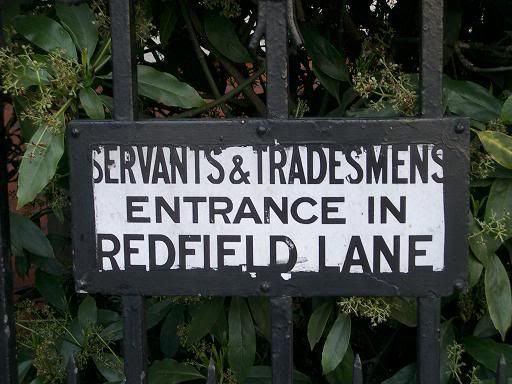 The picture above was not taken in the 19th century; it was taken yesterday – in the Cromwell Road. I was on my way to my favourite hospital. (As I always say, ‘What was good enough for General Pinochet is good enough for me.’ LOL!) I’ve been seeing this sign for years – every time I have a check-up – and it shocks me every time. I’ve always wanted to photograph it but usually when I go to the Cromwell the last thing on my mind is making sure I have my camera with me. Anyway, yesterday I happened to carry it in my bag and it only took a moment to make a record of that leftover of the past, when this kind of segregation was the norm; when there were other signs in windows of boarding houses that read, ‘No Jews, no Irish, no dogs’ (in whatever order).
I wish I could say that the sign is just there because it looks quaint but I can’t swear it is. The Cromwell Road is a posh area and I have a feeling it’s there because it still serves a purpose.
Slap!
Sunday, 1 April 2007
Guest Slapper of the Month XV
My April Guest Slapper let me down yesterday. Maybe she thought it was a joke. I frantically looked around for a replacement and my gaze fell on Lulu, who, I knew, had lots to say about those controversial ID cards. Here’s her last-minute Slap. I will be eternally grateful to her. Yes, I will.
I Don’t Want to be an April Fool.
This is a slap that was never going to be a slap. In fact, for the past year or two, ever since it was first mentioned, I have always thought I would slap the people who were against the idea, for being so British and insular.
But recently I’ve changed my mind.
I’m talking about ID cards. Specifically, the introduction of them in the UK.
In the past months of public discussions, I always used to accept the argument that, if you had any reservations about carrying an ID card, it meant you had something to hide. That law-abiding citizens had nothing to fear from them, and the only reason you might have to be unwilling to prove who you were to anyone who asked you would be a guilty one. They have had them in France, a perfectly civilised democratic country, for tens of years, I would add, and no one makes a fuss there. Anyway, what’s the difference between a driving licence or passport and an ID card?
But things I’ve read, and seen, recently have really undermined my certainty. And no, it’s not about the £88 or whatever it is we are to be charged for the privilege of getting one.
First, as a middle-class, middle-aged white woman, I have to accept that the likelihood of my ID card being demanded for no particular reason by a passing policeman on my way to Tesco is minimal. That doesn’t mean I shouldn’t be concerned about the extra hassle it will cause a young Asian man who’s not wearing a suit and tie – every survey shows the UK police force suffer from ‘institutional racism’, and when doing jury service I saw to my dismay how ‘stop and search’ rights were part of the everyday lives of black kids.
Secondly, the ‘nothing to hide’ argument doesn’t work when taken to its extreme. I am not a terrorist or a drug dealer, but that really, really doesn’t mean I want the intelligence services listening in on my phone line or scanning my e-mail.
Thirdly, the belief that the innocent will have no problems with ID cards assumes that the computer system set up to administer them will be pretty much faultless. And there is simply no British system in the last ten years that hasn’t caused incredible mishaps and misunderstandings and trouble for ordinary people. The new NHS patient-linking data system has been abandoned, as has the computerised system for finding junior doctors a job. You can’t book a train journey without having to sort through up to 36 different prices for the same route, from £12 to £250. The congestion charging system in London sends the bailiffs out to repossess the property of non-fine-payers who in fact had their car stolen and trashed 8 years previously and police reports prove it. And they have written five times with documentary evidence of that fact but no actual person with common sense ever looks at the letters. The child support agency endlessly pursues people who happen to have the same name but live 200 miles away from real absentee fathers, while single mothers struggle to pay their bills. The new passport system, when installed, resulted in daily nine-hour queues down the street for passports for nearly a year before its ‘teething problems’ were resolved. Credit reference agencies blacklist you because someone who lived in your house five years ago didn’t pay their mobile phone bill, even though they are a married man called Robert Black and you are a single woman called Susan White. My GP tells me to pester the hospital myself for my test results because the hospital computer will never connect up patient with GP once you’ve left the building, and she, she says, cannot possibly remember to chase my results for me because she has 3,000 people to think about. The tax office changes its address without informing you, and when you send in your tax return by overnight signed-for mail in plenty of time, it takes five days because they have to forward it on from Cornwall to Newcastle, and then they fine you for being late. Incompetence rules every administrative system, because the people entering working life now and for the past 15 years have received an education that would shame a rogue African state in the middle of a civil war, and cannot actually form a sentence or add two sums.
Fourthly, and most importantly, the ‘ID cards are innocent for innocent people’ argument totally and entirely depends upon there always being a democratic government in place, with a reasonable view on human rights and privacies, to whom one can apply peacefully and democratically to change unfair laws, and whose administrative wings – the police, social services, the courts, the tax office, the armed forces – remain under its control and basically benign. We are incredibly complacent about this in Britain – we don’t bother going to vote, we don’t protest, we sleepwalk our way into the erosion of rights, we’re scared to speak up and offend anyone or stand out from the crowd. We really assume that the situation in Europe today (well, of 20 years ago, actually) – of the West, and late 20th-century western democracy, being forever in charge of the thinking world and hopefully even in the ascendancy – will be the status quo forever. But history does not back this up, and nor do recent events. This struck me at the theatre last week, watching Athol Fugard’s play Sizwe Banzi is Dead, which is about the monstrous Kafkaesque hoops a man – a black man, of course – is made to jump through simply to be allowed to leave his home town, get a job somewhere else and send money home to his wife and children. It’s the tiniest leap – it would take the tiniest event in history (like 9/11) or a simple change of government – to instantly, or, even worse, gradually and sneakily, turn ID cards into a tool for population control in the name of ‘national security’. All that even an elected government has to do is announce ‘special circumstances’ and they can detain people for three months without charge (in the UK, or goodness knows how long in Guantanamo). A move to make people stay in or go back to the city where they were born would be the next step – it’s been a motif throughout history, in communist states, in Russia, right back to the time of Herod. There doesn’t even have to be a pressing reason, it might just strike a government minister as less trouble that way.
And there is a difference between the UK and, say, France. France has a written code or constitution dating back to Napoleon. It enshrines the separation of Church and State, so no religious fundamentalist leader can worm his way into power and change the rules from within. No one politician, in fact, can ever trespass beyond agreed limits. And the French people are ever alert to any erosion of their liberties and take to the streets the minute they are threatened.
So now I’m most certainly slapping ID cards, with all the force I can muster. Is there anyone out there who can change my mind back again, and convince me I’ve nothing to worry about?
Friday, 30 March 2007
We should have a choice, non?
Yesterday I discovered to my dismay that all the waste pipes in my kitchen and bathroom were completely blocked. No, but completely. I couldn’t run water in the sink, washbasin or bath for one second. In this wonderful flat of mine, all the water ends up in the same pipes. (What idiot devised this, back in the 1930s, that’s what I want to know.) I couldn’t understand how my pipes could go from totally clear to 100% clogged up in the space of one day – they were perfectly fine the day before, but I had to do something about it.
In my experience, the only thing that really works when this happens is Mr Muscle Sink & Plughole Unblocker (it’s also the safest, I believe, since it doesn’t harden in the drains). Off I went to my local Tesco to buy some of the stuff. They had a ‘3 for 2’ offer so I came back lugging three bottles of the miracle product (you can’t be too careful, can you?).
Then came the fun part: I got hold of one Mr Muscle and tried to unscrew its cap (no smutty jokes here, please). No could do. It was childproof. I pushed and turned and pushed harder and turned harder, in vain. OK, I had two more chances to succeed. I grabbed another bottle… Nope! Finally, the third Mr Muscle cap yielded to my will. Phew! I poured the gooey liquid through the plughole and let it do its business overnight.
Reader, it worked.
But, what I want to know (apart from who devised the drain system in my building, of course) is why we who are not children, we who do not have any children in our homes, we who can tell the difference between a bottle of Volvic and a bottle of hydrochloride what’s-it, why we have to buy these bottles with childproof caps? I’m little but I have extremely strong hands (ask anyone who’s had their back massaged by me, or, even better, ask Linda Pilkington, the owner of Ormonde Jayne: her hand is probably still smarting from being crushed in mine – I was trying to be friendly, LOL!) and what I can’t open... I was going to say, isn’t worth opening, well, no, but you know what I mean. I understand the need for childproof caps but why can’t we buy bottles, etc. with ordinary caps as well ? I think I know why but I’m asking anyway.
And what about older people with arthritis? (Actually I have a touch of it in my left hand at the moment, but I’m right-handed so it didn’t have a part in my inability to open those bottles.) What if you’re an arthritic person whose pipes are blocked or who wants to take some vitamins so they can live a little longer and bother everyone else with their special requirements, like ‘easy to open containers’? What about them, then?
Slap!
Wednesday, 28 March 2007
Questions
How long before Iran promises to wipe Britain off the map, do you think?
Or isn't Britain such a thorn in its side?
Update (29 March): It's getting there... How unreasonable of Britain to make such a ‘fuss’ about nothing! Tut-tut! (Or should it be ‘Slap’?)
Wednesday, 21 March 2007
For God’s sake!
Did you know that you don’t have to be a Christian to say a prayer talking about ‘crosses’ and ‘churches’? No, neither did I. And did you know that suggesting that Jews might not be comfortable saying such a prayer is being as intolerant as the worst fundamentalist? No, neither did I.
‘Crosses’ and ‘churches’ are Christian symbols – exclusively. They have no place in Jewish religious rituals (I can only speak as Jew in this instance). Many Jews would find mentioning those words in a prayer abhorrent. How could they forget that thousands of other Jews were murdered in the name of the Church, by hordes of devout Christian brandishing crosses? The Christian religion is not universal (it might have wanted to be, once upon a time, but it didn’t manage it, quite). There are prayers that mention god without being so specific; those are fine.
During the war, trying to escape from the Gestapo in la France profonde, my mother was hired as a companion by an old woman, who had portraits of Hitler and Pétain above her bed (could there be a safer place to take refuge in?). Every night, on her knee, the woman prayed God for them. My mother was trying to ‘pass’ as a Christian: she had dyed her hair blonde; she wore a cross and went to church. She was forced to: her life was at stake. She played that difficult role for a few months, until the woman, who was very kind to her and completely unaware of her real identity, gave her away – unwittingly – to a member of the French milice. Luckily, my mother had heard them talking and she left at the earliest opportunity.
I am not a religious Jew, but I would only consider wearing a cross if my life depended on it. As for churches, I like visiting them, for their beauty, their architecture, their art, and I have attended the odd wedding/funeral in them, but I would not worship there.
I don’t care what you believe; just don’t impose your beliefs or your religious symbols on me. And don’t accuse me of intolerance when I object to your trying to do so.
Sunday, 18 March 2007
Supermarket etiquette
Forget about foreign languages, what kids need to learn from an early age is how to shop in supermarkets. We acquire that skill by watching other people, mostly our mummies; unfortunately these days women are as bad at it as men so young shoppers don’t have any role models and Supermarket Rage is a very common occurrence.
Don’t leave your basket or trolley right bang in the middle of the floor! When did this habit start? When did it become OK to block everybody else's way because one is too lazy to carry one's basket to where the pomegranate-juice cartons live? No one would leave their bags unattended in the middle of the pavement while they went into a shop so why do it in a supermarket?
If it says ‘Less than 10 items’ (by the way, resist the urge to tell the manager it should be ‘fewer’: he’s not interested), do not turn up in the queue with a trolley full to the brim and then smile apologetically to the people behind you: it won’t wash.
Don’t leave the stuff you want to buy on the belt while you go off to get an item you forgot to pick up earlier? It's a neat trick, isn't it? You reserve your place in the queue and no one can move your groceries aside without feeling like a louse.
When the cashier begins to check out your purchases, don’t stand there flirting with them or nattering into your mobile; unless you’re very old or suffering from some handicap and are therefore slower than an able-bodied person, don’t wait until you’ve paid, start bagging the stuff now, otherwise the next person will huff and puff and probably curse you to the twelfth generation for keeping them waiting.
Don’t act surprised when the cashier requests money from you. What did you expect? Did you think it was Free Food Day and you wouldn’t have to fork out for your over-packaged cook-chill meals? Hand in your card or cash and then resume packing so by the time they give you your change or ask you to key in your PIN you will have finished and no time will have been wasted.
Finally, don’t hang about checking your receipt while the next person – me – is trying to access their items, which are now tumbling all over the place, get out of the way!
Subscribe to:
Posts (Atom)

